

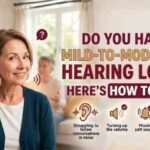
Introduction
Hearing plays a significant role in communication as it enables us to understand speech, process sound, and interact with the world around us. Difficulty hearing may lead to social isolation and cognitive decline. Recognizing the signs and symptoms of mild-to-moderate hearing loss is essential to take the necessary steps to restore hearing ability. Effective ways to assess the range of hearing loss are included in this blog.
What is Mild-to-Moderate Hearing Loss?
Hearing loss occurs when your hearing system is affected in some way. When the hearing threshold of a person becomes 26 dB to 40 dB, it can be categorized as moderate hearing impairment. The person will face difficulty hearing soft sounds, low voices.
People suffering from moderate hearing loss are unable to participate in a conversation with a loud sound in the background. The sound coming from a distance of 3 to 5 feet will be difficult to understand by the person with moderate hearing loss.
Early Symptoms of Mild-to-Moderate Hearing Loss
The symptoms that indicate mild-to-moderate hearing loss need to be observed and assessed properly for your health and well-being. You can ensure the range of your hearing loss by observing the following symptoms:
- Difficult to hear whispers, quiet conversation, and rustling leaves.
- Trouble hearing the sound of speech from a distance.
- High-frequency as well as mid-frequency sounds, such as birds chirping, will be difficult to hear.
- Ask people to speak more loudly, clearly, or repeat words frequently.
- Difficult to understand speech in noisy, crowded areas such as at a concert or on crowded roads.
- Feeling a ringing in the ears or hearing a buzzing sound is called tinnitus.
- I need to turn up the volume of the TV or the sound system.
- Difficulty understanding the sound of speech on the phone, especially in a noisy background.
Treatment Options for Mild-to-Moderate Hearing Loss
The good news is that if you’ve been diagnosed with mild-to-moderate hearing loss, you have multiple options for improving your hearing and it’s one of the more controllable types of hearing loss.
Hearing Aids: The First-Line Treatment
Hearing aids are the main and most successful treatment for the majority of persons with mild-to-moderate hearing loss. Mild-to-moderate hearing loss typically responds quite well to amplification alone, in contrast to severe or profound hearing loss, which occasionally requires a cochlear implant. Soft speech, high-frequency sounds like “s” and “f,” and background noise all become simpler to distinguish from the noise you’re attempting to focus on when an audiologist customizes the device to your unique audiogram.
Medical and Surgical Treatment (When the Cause Isn’t Sensorineural)
A hearing aid is not necessary in every instance of hearing loss. Medication, ear cleaning, or a minor surgical operation can sometimes restore hearing on their own if the reason of your loss is earwax accumulation, fluid behind the eardrum, an ear infection, or a perforated eardrum. For this reason, every suggestion for a device should be preceded by a physical examination and tympanometry, not merely a trial of a hearing aid. We are likewise wary of anyone purchasing a hearing aid online without first checking out a treatable underlying condition.
Auditory Rehabilitation and Communication Training
Your brain still needs to relearn how to interpret sound even after wearing hearing aids, particularly if you’ve had untreated hearing loss for a long time. During the first few months of using a new hearing aid, lip-reading signals, auditory training activities, and communication strategy coaching (such as facing the speaker in noisy spaces) are frequently advised.
Assistive Listening Devices (ALDs)
TV streamers, amplified phones, and FM systems are examples of assistive listening equipment that can be used in conjunction with hearing aids or as a lighter-touch option for extremely slight loss in certain contexts, such as watching TV, attending lectures, or speaking on the phone.
Tinnitus Management, When Present
Tinnitus, or ringing or buzzing in the ears, frequently coexists with mild-to-moderate hearing loss. Another reason a correct fitting is more important than simply selecting a device off a shelf is that many contemporary hearing aids come with built-in tinnitus masking or sound therapy programs.
Tests and Diagnoses of Moderate Hearing Impairment
Diagnosis of mild-to-moderate hearing loss can be done by a professional, like an audiologist. They evaluate the range of hearing loss through physical tests as well as several audiometry tests.
Physical Examination for Mild-to-Moderate Hearing Loss
Your audiologist will ask the following questions:
- If you are facing trouble hearing the sound of the TV or radio at its usual volume, and need to turn up the volume?
- Do you tell your friends or family members to repeat themselves?
- Are you facing difficulties hearing the sound of speech on the phone?
- How much time do you spend in noisy areas?
After completing the physical examination, you will be advised to undergo several audiometric tests, if your doctor finds it necessary.
Audiometer Test
An Audiometer Test is suggested to ensure the hearing difficulty as well as the degree of hearing loss. During this test, different pitches, tones, decibels, and loudness are being played through headphones. The audiologist then observes your reactions and, through this excellent way, your degree of hearing loss can be determined.
Speech Testing
This Speech test is necessary to check your ability to understand the sound of speech in noisy places. It also determines your SRT (Speech Reception Threshold).
Tympanometry
This test (Tympanometry) helps to assess the movement of the eardrum and check the condition of the middle ear fluid.
ABR Test (Auditory Brainstem Response)
In an ABR test, several electrodes are placed on the head near the ears to detect the brain’s response to different sounds played through earplugs placed in the ear. The integrity of the auditory nerve can be evaluated through this test.
Best Hearing Aids for Mild-to-Moderate Hearing Loss in India
A few brands are frequently mentioned by Indian audiologists as reliable options for mild-to-moderate hearing loss, but there isn’t a single “best” hearing aid—the appropriate one depends on your degree of loss, lifestyle, and price.
Top Brands to Know
- Phonak: Considered the industry standard, this device has AutoSense OS, which is incredibly helpful in Indian cities as it automatically switches between quiet rooms and busy streets.
- Signia is renowned for its robust app-based control and organic, less “processed” sound quality.
- Oticon: The sound processing is trained on a wide variety of real-world surroundings, making it popular with users who prefer to listen with relatively little mental effort.
- In the mid-to-premium category, Widex and ReSound both provide reliable rechargeable and Bluetooth-enabled alternatives.
- Starkey is a reputable brand that offers a variety of products from entry-level to luxury.
What They Cost in India
In India, the cost of hearing aids varies greatly: entry-level digital devices normally cost between ₹18,000 and ₹30,000 per ear, mid-range rechargeable and Bluetooth models typically cost between ₹60,000 and ₹1,50,000, and high-end AI-driven devices with sophisticated noise separation can cost up to ₹5,00,000 or more each ear. You rarely require the most expensive tier, especially for mild-to-moderate hearing loss; a well-fitting mid-range device frequently works just as well for voice clarity and daily conversation.
Which Style Suits Mild-to-Moderate Loss?
Here are the different types of hearing aids available,
- Receiver-in-Canal, or RIC, is the most widely advised type for mild-to-moderate loss; it is discrete, cozy, and suitable for the majority of lifestyles.
- Completely-in-Canal, or CIC, is a very discrete solution that works well for mild to moderate high-frequency hearing loss.
- BTE (Behind-the-Ear): Often favored by novice users or senior citizens, it is slightly more noticeable but simpler to use.
The One Step That Matters More Than the Brand
A mid-range hearing aid that is appropriately tuned to your audiogram will operate better than an expensive one that hasn’t been fitted correctly, something that most purchasing guides don’t make obvious enough. Getting a proper audiometric evaluation and a fitting session with genuine ear measurements is more important than brand and price since it verifies that the device is actually providing the correct amplification to your eardrum, not just what the factory preset assumes.
Why is it important to check your hearing health?
Hearing ability is one of the most important aspects of our lives. It is necessary to be aware of our auditory health. We should check the range of our hearing loss for our overall health and well-being.
-
Early detection
Early detection of your hearing loss is possible by regular hearing checkups. You can be able to start treatment from the initial stage. You need to check the range of your hearing loss to take proactive steps to prevent further deterioration.
-
Prevent cognitive decline
Untreated hearing loss may lead to cognitive decline. When the ears are not working properly, our brain needs to work harder; this can affect cognitive function. Checking your hearing capacity is necessary to prevent cognitive decline, which includes dementia and Alzheimer’s disease.
-
Health and safety
Hearing loss can cause several dangers, such as the approaching sound of horns of vehicles or alarms. Testing your hearing issue is beneficial to ensure your safety. Hearing loss affects the balance of your body, so it is necessary to identify the root cause for your health and wellness.
-
Enhance quality of life
Restoring hearing capacity is essential to improve the quality of life as it allows you to connect with your friends and family members. Ignoring hearing loss may lead to reduced social interaction and feelings of isolation. Proper assessment of your hearing problem is necessary to improve the quality of life.
-
Improve communication
It is important to detect if your hearing issue is mild or moderate. Early detection and proper treatment are helpful to restore your ability to communicate. Using appropriate hearing aids can pave the way to having good communication with others.
If you are facing trouble with hearing, no need to be anxious, you can contact us at Aural Care, a renowned hearing solution providing clinic in Kolkata, to get proper hearing treatment. We use advanced equipment to check the range of your hearing loss through several audiological tests such as ASSR, Tympanometry, and BERA. We emphasize recognizing the cause behind your hearing loss; for this, we offer vestibular function tests. Our expert and experienced audiologists assess your hearing issue and suggest the best solution. Contact us to relieve discomfort caused by hearing issues.
Conclusion
It allows us to stay connected with our surroundings and interact with others. One should be aware of the hearing issues he is suffering from. Several effective audiological tests can be beneficial to analyse the degree of your hearing loss. Proper diagnosis and treatment are necessary to enhance your quality of life.
FAQs
Is mild-to-moderate hearing loss the same as partial deafness?
A: Not really. “Audiologists use measured hearing thresholds instead of the clinical term “partial deafness,” which is more commonplace. The majority of persons with mild-to-moderate hearing loss can still follow a discussion in a quiet environment, but they struggle mostly in situations with soft speech or loud noises. This level of hearing loss is far above total deafness. The true picture, which is more important than the label, is provided via an audiometric test.
What levels of hearing loss are considered mild-to-moderate?
A: The mild-to-moderate range is made up of mild hearing loss, which is between 26 and 40 dB, and severe hearing loss, which is between 41 and 55 dB. In ordinary parlance, minor loss is the inability to hear a soft voice or whisper; moderate loss makes it more difficult to follow a typical conversation from a few feet away, particularly when there is background noise. You can see exactly where you fall on your audiogram.
What age group is most affected by mild-to-moderate hearing loss?
A: Age-related hearing loss does increase after 60, and it’s frequently thought of as an older person’s problem. However, we frequently observe it in individuals in their 30s and 40s as well; it is typically associated with exposure to noise from work, traffic, or headphones. Children may also be impacted. Age increases the risk, although it is not a prerequisite for screening.
What is the prognosis for mild-to-moderate hearing loss?
A: First, the good news is that this type of hearing loss is one of the easier to treat. If a mechanical issue, such as a buildup of oil or wax, is the cause, it can be fixed. If sensorineural, it is typically irreversible but responds favorably to long-term hearing aids. The diagnosis itself is not the true risk; rather, it is the years of untreated illness.
Follow us on
- Facebook: facebook.com/AuralCareKolkata
- You tube: youtube.com/@AuralCareOfficial
Visit us
Location: GB7, 822, Rajdanga Main Road . Opp. GST Bhawan. Kol 700107