
The 1 3 6 rule in audiology is one of the most effective and established procedures to detect as well as to treat the range of hearing loss among the newborns. This blog focuses on the JCIH 1 2 3 rule and it’s important to cure hearing loss at an early stage. Advantages of rule 3 masking and the concept of 4 Ps are also included here. This blog provides a complete guidance of the entire process to detect hearing disability in your newborn baby and to evaluate the condition and also to cure the health issues.
What is the 1 3 6 rule in audiology ?
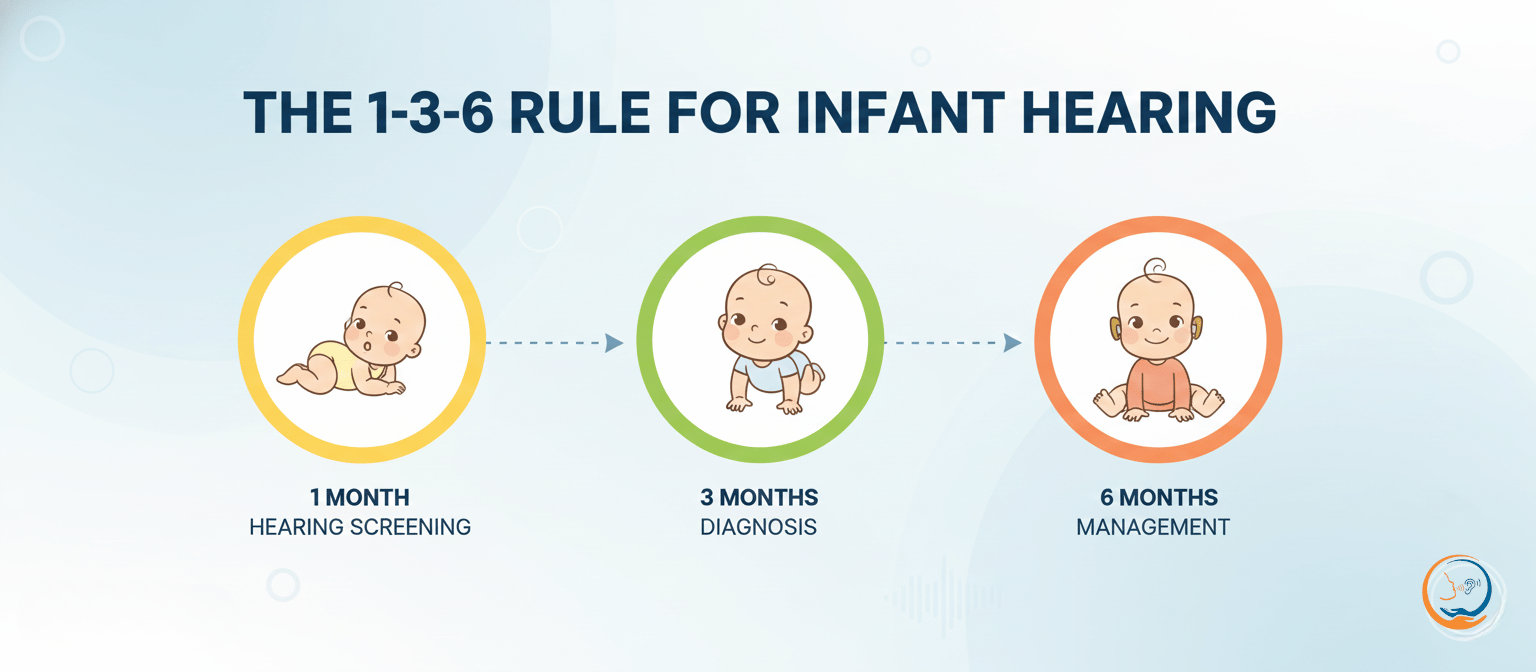
A guideline to evaluate the range of hearing loss at 1 month of age and it continues to 6 months. This process helps in detection of hearing issues and in intervention of the infants. The procedure is as follows:
First month- A newborn baby gets a screening test in the first month.
Third month- A newborn baby needs to receive a proper diagnosis if any risk factor has been noticed in the previous test.
Sixth month- If a hearing issue has been detected, the baby needs to have an intervention. Early intervention is necessary to cure the hearing loss at the early stage.
The importance of the 1 3 6 rule in audiology lies in the understanding of the listening disability of the growing baby. It also helps to to avoid any hindrance to communicate with the surroundings
What is JCIH 123 rule?
It is a benchmark announced by the Joint Committee on Infant Hearing (JCIH) to detect hearing loss among infants. Early monitoring and a proper intervention are effective for the infants with mild complications or for the deaf. According to the rule :
1 month – A screening test for hearing capacity is performed at the 1 month of age. It is done through a physiological measure.
2 months – At the age of 2 months the infant who fails to meet the benchmark in the earlier test goes through diagnosis to detect the hearing complications.
3 months – After detecting the hearing loss the infants must have medical intervention.
What is rule 3 masking in audiology?
In the case of conductive hearing loss in the non test ear, the rule 3 masking is recommended for accurate diagnosis. The purpose of the rule 3 masking is recognising the AC threshold while the other ear has conductive hearing loss.
Understanding the condition when the masking is needed is discussed in the following points. You can check the rule from here:
- The masking is necessary when the ear threshold is lower by 50 db or more than the air conducting threshold of the other ear with better condition, in the air conduction testing process.
- In air conduction test, When the ear threshold is worse by 50 db or more than the bone conduction of the ear in better condition, for the non test ear making is needed.
- The non test ear is needed to be marked when the test ear has the air bone gap 15 db or more than that in the bone conduction test.
What is the 1/2/3 rule of the Joint Committee on Infant Hearing on Infant Hearing 2019 position statement?
The Joint Committee on Infant Hearing has announced a timeline in its 2019 position statement for the early detection, diagnosis and intervention of the hearing issues among the newborns. It aims to identify the difficulties related to hearing at an early age so that proper treatment can be started as early as possible.
The infants have already met the 1 3 6 benchmark and should go through the 1 2 3 month procedure.
- At 1 month of age a screening test for hearing is performed.
- Month 2 is recommended for the audiological diagnosis to confirm the hearing loss.
- At month 3 the infant with hearing loss receives intervention services.
What are the four Ps of hearing loss?
4Ps of hearing loss refers to the four types of hearing loss. The classification of the hearing loss is – Sensorineural, Conductive, mixed and Auditory Neuropathy Spectrum Disorder. You can check from here:
1. Sensorineural hearing loss– This type of hearing loss occurs due to the damaged auditory nerve or the inner ear.
2. Conductive hearing loss- Through the outer or middle ear when the sound can be conducted properly, it results in this kind of hearing loss.
3. Mixed hearing loss- In this hearing loss a person suffers from both the sensorineural as well as the Conductive hearing loss.
4. Auditory Neuropathy Spectrum Disorder- In some cases sound enters into the inner ear but the brain can not process the sound properly, such conditions lead to Auditory Neuropathy Spectrum Disorder.
Also read: What Are The Differences between Conductive vs. Sensorineural Hearing Loss
If you want to ensure your baby’s hearing ability, you can contact us at Aural Care is one of the well known Audiologist in Kolkata offering screening, diagnosis and treatment through the advanced technology and services. We are here to provide you with complete care to restore your hearing ability and offer you a natural listening experience.
Join us today to have a natural hearing experience.
Conclusion
1 3 6 rule in audiology is a well established bench mark to find out hearing difficulty by a thorough monitoring from 1 month to 6 month of age of a baby. JCIH 1 2 3 rule provides accurate insight about the hearing issues of infants. Screening, diagnosis and intervention are the steps to detect the root causes of hearing loss. 4Ps are the types of hearing loss This blog helps to understand what kind of hearing loss you are suffering from.
Through this effective process early detection of listening difficulties can be possible and it also enables you to take necessary actions accordingly. Consulting with an expert audiologist at the early age of your baby is beneficial to provide a hassle free and natural hearing experience from the beginning of life.
Follow us on
- Facebook: facebook.com/AuralCareKolkata
- Instagram: instagram.com/auralcareofficial
- You tube: youtube.com/@AuralCareOfficial